
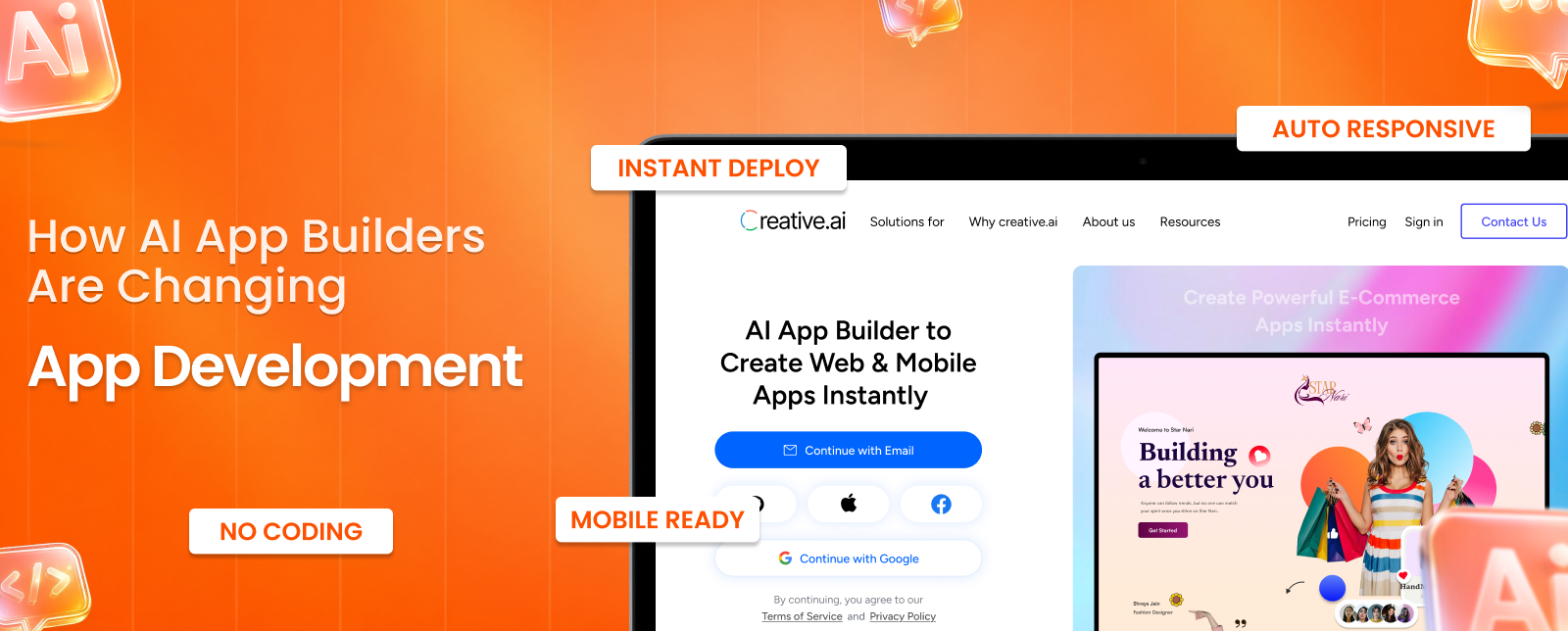
A year ago, most startup teams still treated app development like a linear process. Product spec first. Design second. Engineering after that. Validation came late, usually after weeks of work.
That workflow is breaking down.
The rise of AI app builders is changing how products are planned, tested, and shipped. Not because teams suddenly stopped caring about quality. Because speed changed the economics of decision-making.
When building becomes faster, the bottleneck shifts elsewhere.
Now the real challenge is deciding what deserves to be built in the first place.
Traditional development workflows were expensive by default.
Even simple product ideas are required:
UI design
frontend development
backend setup
API connections
testing infrastructure
deployment workflows
That created friction early. Teams avoided experimentation because every experiment carried an engineering cost.
A modern AI app builder changes that equation.
Instead of spending weeks translating ideas into prototypes, product teams can generate working flows in hours. Screens, logic, layouts, forms, dashboards, and onboarding systems can now be created from prompts and refined iteratively.
That changes team behavior.
Founders test more ideas. Product managers validate assumptions earlier. Designers spend less time rebuilding repetitive interfaces. Engineers focus more on architecture and less on boilerplate.
The workflow becomes operational instead of sequential.
Faster development sounds simple until teams realize what happens next.
When execution becomes easier, prioritization becomes harder.
A no-code AI app builder removes technical friction, but it also expands the number of things a team could build. Suddenly:
more features feel possible
More experiments seem reasonable
More stakeholder requests enter the roadmap
That creates a different kind of operational risk.
Teams can now ship the wrong thing faster.
The best companies are adapting by changing how they evaluate product decisions. They are treating AI-generated apps as validation environments, not final products.
For example:
A startup tests three onboarding flows in one week instead of debating one for a month
An operations team prototypes an internal dashboard before allocating engineering resources
A founder validates demand for a niche workflow before hiring developers
The output matters. But the learning velocity matters more.
Early-stage startups benefit the most because they operate under extreme uncertainty.
Before AI tooling, founders often had to choose between:
spending money on development
delaying product validation
shipping unfinished MVPs
Now, an AI app generator can help compress that cycle dramatically.
A small team can:
generate UI layouts
build admin panels
connect workflows
test user journeys
automate repetitive setup tasks
without building everything manually from scratch.
That does not eliminate engineering. It changes where engineering time gets spent.
Instead of rebuilding standard components repeatedly, developers can focus on:
performance
scalability
infrastructure
security
system reliability
custom product logic
The repetitive layer of software development is increasingly becoming automated.
One of the biggest changes is cultural, not technical.
AI tooling is making product organizations more comfortable with iteration.
Previously, teams delayed decisions because revisions were expensive. Now revisions are expected.
An AI app builder allows teams to compare workflows quickly:
Different onboarding sequences
Checkout experiences
CRM structures
Approval systems
Reporting dashboards
That creates tighter feedback loops.
A product manager no longer needs to wait for an entire sprint cycle to test an assumption. Internal tools, prototypes, and customer-facing flows can be generated and reviewed much earlier.
This is especially valuable for operational software.
Many businesses do not need highly custom systems immediately. They need working systems quickly:
Inventory management
Client portals
Scheduling systems
Workflow automation
Internal reporting tools
Speed reduces operational drag.
Most discussions around AI development tools focus on productivity.
That misses the bigger shift.
The strongest teams are using AI to improve decision quality.
A no-code AI app builder helps companies:
Validate earlier
Reduce unnecessary engineering work
By testing assumptions faster
Identify bottlenecks sooner,
Compare execution paths before committing resources
That changes how organizations allocate time and money.
Instead of investing heavily before validation, teams can gather evidence first.
And in modern product development, evidence compounds.
AI-generated software is not replacing product teams. It is changing what product teams spend time on.
The value is moving away from raw implementation and toward:
System thinking
Workflow design
Product judgment
Prioritization
Infrastructure decisions
Customer understanding
Building apps is becoming easier.
Knowing what to build is becoming the real competitive advantage.
That is why the AI app builder market is growing so quickly. Not because companies want fewer developers. Because modern teams need faster feedback, tighter execution loops, and better operational decisions.
The teams that adapt first will not necessarily build more software.
They will build fewer wrong things.
An AI app builder helps users create apps faster using AI-generated workflows, layouts, and automation.
A no-code AI app builder allows users to build apps without writing complex code manually.
Yes. Startups use them to validate ideas, build MVPs, and launch products faster.
No. It reduces repetitive work so developers can focus on scalability and product logic.
They help teams ship faster, test ideas earlier, and reduce development costs.
Turn your ideas into fully functional apps using intelligent automation. Design, build, and launch, all in one seamless workflow.
Build Your App Today!